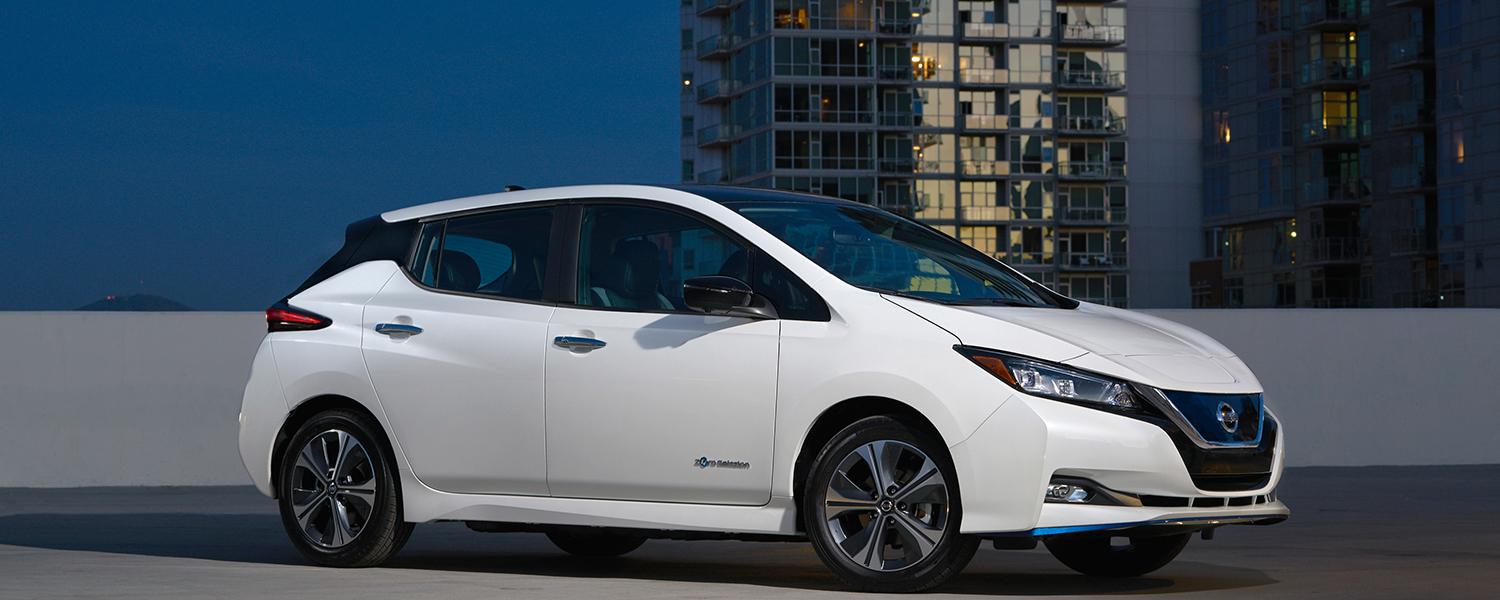
2019 Nissan LEAF PLUS Overview
Since its launch in 2010, Nissan LEAF has been the best-selling electric vehicle in the world2, offering strong performance, striking design and cutting-edge technologies at an affordable price. The all-new second-generation design Nissan LEAF, introduced for the 2018 model year, now offers an expanded lineup with the introduction of the 2019 Nissan LEAF PLUS. It goes on sale in the United States and Canada in spring 2019.
The “PLUS” designation refers to the increased energy density of the model’s 62 kWh battery pack and the higher output of its powertrain. The Nissan LEAF S PLUS new powertrain adds to the car’s range by approximately 50 percent, with an EPA range of up to 226 miles1, ensuring that there’s a Nissan LEAF to meet the driving needs of a wider range of customers.
The high-capacity battery and more powerful 160 kW motor in the Nissan LEAF PLUS combine to produce 214 horsepower – an increase of 45 percent – and 250 lb-ft of torque. The standard 2019 Nissan LEAF offers a 40 kWh battery pack with an EPA range of 150 miles3.
Now available in two versions, the Nissan LEAF embodies Nissan Intelligent Mobility, the company’s vision for changing how cars are powered, driven and integrated into society. The three key aspects of Nissan Intelligent Mobility, exemplified by the 2019 Nissan LEAF, are Nissan Intelligent Driving, Nissan Intelligent Power and Nissan Intelligent Integration.
The Nissan LEAF family of electric vehicles also plays a significant part in Nissan’s efforts to integrated electric vehicles and energy systems into customers’ lives, creating an “EV ecosystem.”
Nissan Intelligent Power: increased range and performance
The Nissan LEAF PLUS, a new version of the Nissan LEAF’s revolutionary electric powertrain, delivers excellent energy efficiency and robust torque and power output. With its EPA range of up to 226 miles1, the Nissan LEAF PLUS allows customers the ability to do more between charges.
The new powertrain also allows faster acceleration when driving at high speeds. Accelerating from 50 mph to 75 mph is nearly 13 percent quicker than the standard Nissan LEAF. This allows the Nissan LEAF PLUS to confidently pass slower-moving vehicles, exit corners faster and more seamlessly, and merge easily with fast-moving traffic. The top speed has increased by approximately 10 percent for comfortable cruising.
In addition, thanks a standard new 100kW capacity quick charging system, the 2019 Nissan LEAF PLUS can charge more efficiently.
Even with a 25 percent increase in energy density and the increase in energy storage capacity, the Nissan LEAF PLUS battery pack is almost the same size and configuration as the pack in the Nissan LEAF. Other than a 0.2-inch increase in overall height (16-inch wheels), the car’s exterior and interior dimensions are unchanged. Because ownership satisfaction and peace of mind are pivotal for all Nissan LEAF owners, the battery limited warranty of 8 years/100,000 mile4 (whichever occurs first) is standard for all versions.
Nissan Intelligent Driving: innovative ProPILOT Assist and e‑Pedal
Playing a leading role in Nissan Intelligent Driving is ProPILOT Assist5, a single lane highway driving assist technology that can automatically adjust the distance to the vehicle ahead, using a speed preset by the driver.
ProPILOT Assist can also help keep the vehicle centered in its lane. If the car in front stops, ProPILOT Assist can automatically apply the brakes to bring the vehicle to a full stop if necessary. After coming to a full stop, the vehicle can remain in place even if the driver's foot is off the brake. If traffic restarts, the car will resume driving when the driver touches the steering wheel-mounted ProPILOT Assist switch again or lightly presses the accelerator to activate the system. All these functions can help reduce stress when driving on the highway in both heavy traffic and long commutes.
Further enhancing the Nissan LEAF’s driving experience is e‑Pedal6, which allows the driver to start, accelerate, decelerate and stop using only the accelerator pedal. To match the Nissan LEAF PLUS additional power and increased mass, Nissan has reprogrammed the e‑Pedal software for smoother operation and enhanced pedal feedback, especially for operation in reverse, and for smoother and more rapid deceleration, making it easier to stop the car using e‑Pedal, even when backing up.
Along with ProPILOT Assist and e‑Pedal, the Nissan LEAF PLUS is equipped with a set of available advanced safety technologies including Intelligent Lane Intervention (I-LI), Lane Departure Warning (LDW), Automatic Emergency Braking (AEB) and Automatic Emergency Braking with Pedestrian Detection, Blind Spot Warning (BSW), Rear Cross Traffic Alert (RCTA) and Intelligent Around View® Monitor (I-AVM).
Nissan Intelligent Integration: updated interface, larger display
The new Nissan LEAF PLUS links drivers, vehicles and communities through its convenient graphic-based Human Machine Interface. It allows the owner to use the NissanConnect®7 smartphone app to perform tasks such as monitoring the vehicle’s state of charge, scheduling charging to benefit from optimal energy tariffs, finding the nearest charging station, and heating or cooling the car before getting in.
New for the Nissan LEAF PLUS is a larger, thin-film transistor, full-color 8-inch display, with an updated navigation system that can be linked to a compatible smartphone. The display features smartphone-like operation including swiping, scrolling and tapping, applications, maps and firmware are updated over the air with the simple touch of a button, instead of having to manually update by USB or at a Nissan dealership.
Other new features include Door-to-Door Navigation, which syncs the vehicle’s navigation system with your compatible smartphone for seamless driving and walking directions. The connections feature allows any of the car’s passengers to quickly and easily connect to a device within the vehicle.
Integration goes beyond what’s in the vehicle and now includes Nissan Energy, the company’s existing and future initiatives for Vehicle-to-Grid, Vehicle-to- Building and Vehicle-to-Home connections, generating solar electricity, as well as reusing batteries. With Nissan Energy, Nissan LEAF vehicles are part of a larger electric vehicle ecosystem.
Chassis and body
When it comes to performance and agility, the 2019 Nissan LEAF and Nissan LEAF PLUS excel. To match the improved output of the electric motor and inverter (versus the previous generation design), Nissan engineers enhanced the car’s chassis for better stability. Heavy components, including the battery, are placed in the center of the body, helping achieve smaller yaw moments of inertia compared with front-engine vehicles and thereby improving directional stability, enabling smoother cornering.
The electric power steering system has a linear feel that enhances confidence, especially on highways, with enhanced feedback from the road surface. Every 2019 Nissan LEAF also comes with Intelligent Ride Control for more precise electric motor torque control generation when cornering, reducing vibration while simultaneously improving ride quality and steering control.
Sleek modern design
One of the most eye-catching exterior elements of the new Nissan LEAF PLUS is the car’s sleek, streamlined silhouette, which maximizes aerodynamic efficiency. The car’s bold fascia features Nissan’s signature V-Motion grille with blue 3D mesh. The car’s streamlined profile gives it a sporty look, while the rear features a distinctive tail light design. Thanks to the aerodynamic body styling, including a rear bumper with a clear-cut curve and aero-design wheels, the Nissan LEAF PLUS has a 0.28 coefficient of drag.
The angle of the charging port at the front is designed for convenience, letting the customer connect the charging cable without bending down. Ergonomic testing by Nissan shows that the 45-degree angle allows drivers of all heights to easily and comfortably connect the charger.
The Nissan LEAF PLUS carries over most of the standard Nissan LEAF’s design. Subtle clues to its PLUS designation include a revised front fascia with blue highlights and an e+ logo plate on the underside of the charge port lid. There are also rear trim level badges designating the grade levels as S PLUS, SV PLUS and SL PLUS.
The 2019 Nissan LEAF PLUS is available in seven body colors: Brilliant Silver Metallic, Gun Metallic, Super Black, Scarlet Ember Tintcoat (premium color – pearl metallic plus tinted clearcoat), Pearl White Tricoat (premium color), Glacier White, Deep Blue Pearl. It is also offered in one two-tone exterior paint treatment, Pearl White/Super Black.
Like the standard model, the Nissan LEAF PLUS boasts a spacious, highly functional interior with a quality, high-tech feel. The combination of premium materials throughout the cabin befits a luxury vehicle. Vibrant blue contrast stitching for the steering wheel, seats and instrument panel accentuate the car as a Nissan electric vehicle.
All 2019 Nissan LEAF models feature a roomy, open cabin highlighted by the brand’s “Gliding Wing” design language. The driver information display has a simple, light configuration without excessive decoration. It focuses on visibility, creating a tasteful, understated look and feel with both excellent spaciousness and functionality.
Through the thoughtful design of the center console and switchgear, the Nissan LEAF gives drivers the information they need where they need it. This helps them focus on what really matters the most – an enjoyable drive. When the car is activated, a start-up animation is displayed, giving the driver a sense of excitement about driving an electric car.
Using NissanConnect, a key part of Nissan Intelligent Integration, the driver can search for continuously updated information such as the location and operating hours of free charging stations and charging station availability. Owners can also access their smartphone to check the car’s battery status.
Energy-efficient air-conditioning and heating systems provide elevated comfort inside the cabin for all occupants. An available smartphone app provides convenience features such as remote pre-conditioning of the vehicle’s interior temperature and wireless remote charging.
The cabin’s interior dimensions comfortably accommodate five people, while the rear cargo area is designed to provide ample luggage space, offering 23.6 cubic feet of available stowage. The rear cargo space can accommodate two large suitcases or three medium-sized, airline carry-on suitcases. It also allows for easy charging cable storage.
Nissan LEAF PLUS: Three well-equipped models
The new Nissan LEAF PLUS is offered in three well-equipped grade levels: S PLUS, SV PLUS and SL PLUS.
The 2019 Nissan LEAF S PLUS comes complete with 160 kW electric motor, 62 kWh Lithium-ion battery with up to 226-mile range1, high output Quick Charge Port, 16-inch aluminum-alloy wheels, regenerative braking system, e‑Pedal Mode with Hill Hold Assist, portable trickle charge cable (120V EVSE), Automatic Emergency Braking (AEB), automatic on/off headlights, Nissan Intelligent Key™ with Push Button Start, Bluetooth® Hands-free Phone System, Streaming Audio via Bluetooth®, SiriusXM® Satellite Radio (SiriusXM® subscription required, sold separately), Hands-free Text Messaging Assistant, Automatic Temperature Control with HVAC timer (pre-heat/pre-cool cabin) and charging timer (set desired charge time), 8.0-inch information display, 60/40 split fold-down rear seat and much more.
The Nissan LEAF SV PLUS grade adds 17-inch aluminum-alloy wheels, fog lights, leather-wrapped steering wheel, NissanConnect with Navigation and Services featuring Apple CarPlay® and Android Auto™, NissanConnect Services Powered by SiriusXM®, Intelligent Cruise Control (ICC) and two additional speakers (six total).
The top-of-the-line Nissan LEAF SL PLUS features LED headlights and LED signature Daytime Running Lights, heated outside mirrors with integrated turn signals, leather-appointed seats, 8-way power driver’s seat with 2-way lumbar support, heated front seats, heated steering wheel, cargo cover, auto-dimming inside mirror, HomeLink® Universal Transceiver, Bose® Premium Audio with seven speakers, Blind Spot Warning (BSW), Rear Cross Traffic Alert (RCTA), Intelligent Around View® Monitor (I-AVM), Intelligent Driver Alertness (I-DA), hybrid heater, rear heater ducts, ProPILOT Assist, Automatic Emergency Braking with Pedestrian Detection, Electric Parking Brake (ePKB), High Beam Assist (HBA) and Intelligent Lane Intervention (I-LI).
# # #
1. EPA range for Nissan LEAF S PLUS only. Actual range will vary with trim levels, options and driving conditions; see Customer Disclosure Form for details.
2. Based on cumulative sales data from December 2010 to December 2018.
3. Projected MY19 EPA range of 150 miles. Actual range may vary based on driving conditions. Use for comparison only.
4. The limited Nissan LEAF lithium-ion battery warranty includes coverage for defects in materials or workmanship for 8 years / 100,000 miles (whichever comes first) as well as protection against capacity loss below 9 bars of capacity (out of 12) as shown on the Nissan LEAF’s capacity gauge for a period of 8 years / 100,000 miles (whichever comes first). For complete information concerning coverage, conditions and exclusions, see your Nissan dealer and read the actual New Vehicle Limited Warranty booklet.
5. ProPILOT Assist cannot prevent collisions. It is the driver’s responsibility to be in control of the vehicle at all times. Always monitor traffic conditions and keep both hands on the steering wheel. System operates only when lane markings are detected. Does not function in all weather, traffic and road conditions. System has limited control capability and the driver may need to steer, brake or accelerate at any time to maintain safety. See Owner’s Manual for safety information.
6. Monitor traffic conditions and use conventional brake as needed to prevent collisions. See Owner’s Manual for safety information..
7. Available services/features may be described. Compatible connected device may be required. Only use services/features and device when safe and legal to do so. Subject to GPS and wireless network availability and connection, and system/technology limitations. Text rates/data usage/subscription may apply. Some services/features provided by companies not within Nissan or its partners’ or agents’ control and may be discontinued at any time. For more information, see dealer, Owner’s Manual, or www.NissanUSA.com/connect/important-information.
8. Does not detect people or cargo. Always check rear seat before exiting..
2019 Nissan LEAF Overview
- Nissan LEAF offers a 150-mile range3 at an affordable price – with strong performance, striking design and cutting-edge technologies
- Since its launch in 2010, Nissan LEAF has been the #1 mass production EV in the world4
The 2019 Nissan LEAF again sets the standard in the growing market for mainstream electric vehicles by offering customers great range, advanced technologies and a dynamic design.
Introduced just last year, the all-new second-generation Nissan LEAF continues as the embodiment of Nissan Intelligent Mobility, the company's approach to changing the way cars are driven, powered and integrated into society. The three key aspects of Nissan Intelligent Mobility, exemplified by the 2019 Nissan LEAF, are Nissan Intelligent Driving, Nissan Intelligent Power and Nissan Intelligent Integration.
With its dynamic design and advanced technologies such as ProPILOT Assist and ePedal, Nissan LEAF continues to be the best-selling 100-percent electric vehicle in the U.S. and the world. For 2019, LEAF adds standard Rear Door Alert (RDA)5 (late availability), a system that can help remind customers of items that may be forgotten in the rear seat.
Another version of the 2019 LEAF with a higher range will be introduced at a later date.
Nissan Intelligent Driving
Headlining the 2019 Nissan LEAF's Intelligent Driving technologies are ProPILOT Assist and e‑Pedal. ProPILOT Assist is a single-lane highway driving assistance technology. Once activated, it can automatically maintain the distance to the vehicle in front, using a speed and distance preset by the driver.
It can also provide steering assistance to help keep the vehicle centered in its lane. If the car in front stops, the ProPILOT Assist system can automatically apply the brakes to help bring the vehicle to a full stop if necessary. If traffic restarts, the car will resume driving when the driver touches the switch again or lightly presses the accelerator to activate ProPILOT Assist. All these functions can help reduce stress when driving on the highway in both heavy and flowing traffic.
Another innovation that enhances the Nissan LEAF's driving experience is the e‑Pedal, which is offered as standard equipment on all grade levels. It allows the driver the simplicity of accelerating, decelerating and stopping the car by using the accelerator pedal alone — a revolutionary innovation that can change the way people drive.
By simply releasing the accelerator, the car will come to a smooth and complete stop without the need to press the brake pedal. With a deceleration rate of up to 0.2g, the e‑Pedal eliminates the need for drivers to constantly move their foot from the accelerator to the brake pedal to slow down or stop. This can help reduce stress and increase enjoyment.
Studies by Nissan in Japan, Europe and the U.S. have shown that the Nissan LEAF's e‑Pedal reduces the number of times the driver must apply the brakes while commuting in heavily congested traffic. The conventional brake pedal must still be used in aggressive braking situations.
Along with ProPILOT Assist and e‑Pedal, the Nissan LEAF is equipped with a set of available advanced safety technologies including Intelligent Lane Intervention (I-LI), Lane Departure Warning (LDW), Automatic Emergency Braking (AEB) and Automatic Emergency Braking with Pedestrian Detection, Blind Spot Warning (BSW), Rear Cross Traffic Alert (RCTA) and Intelligent Around View® Monitor (I-AVM).
Nissan Intelligent Power
The focal point of Nissan Intelligent Power in the Nissan LEAF is the e-powertrain, which offers improved energy efficiency and increased torque and power output. The e-powertrain delivers an exhilarating, linear driving performance with a power output of 147 horsepower – 37 percent more than the previous-generation Nissan LEAF. Torque has been increased 26 percent to 236 lb-ft, resulting in improved acceleration.
The 2019 Nissan LEAF's lithium-ion battery pack delivers an estimated range of 150 miles3, which should satisfy the daily driving needs of the majority of Nissan LEAF owners. The battery design adds energy-storage capacity without increasing the size of the battery pack – occupying the exact same dimensions as that of the previous-generation Nissan LEAF. The individual cell structure of the laminated lithium-ion battery cells have been improved, representing a 67 percent increase in energy density versus the original 2010 Nissan LEAF model.
Another key engineering achievement for the lithium-ion battery pack is the use of enhanced electrode materials with revised chemistry, resulting in higher power density while contributing to greater battery durability upon charge and discharge.
Nissan Intelligent Integration
The 2019 Nissan LEAF links drivers, vehicles and communities through the user-friendly NissanConnectSM feature and systems that share power between electric vehicles and homes, buildings and power grids.
Using Nissan's LEAF-To-Home™ vehicle-to-home technology, the battery makes it possible to store surplus solar power during the daytime and then use it to help power the home in the evening. The customer can also recharge the battery in the middle of the night, when prices are lowest in some markets, and then use the electricity during the day to reduce energy costs. LEAF-To-Home™ also enables a Nissan LEAF to meet typical household electricity needs for up to two days if the power is disrupted.
The intuitively designed interface on the Nissan LEAF smartphone app allows users to monitor the vehicle's state of charge, schedule charging to benefit from optimal energy tariffs, find the nearest charging station, and pre-heat or cool the car before getting in.
Chassis and body
When it comes to performance and agility, the 2019 Nissan LEAF excels. To match the improved output of the electric motor and inverter (versus the previous generation design), Nissan engineers enhanced the car's chassis for better stability. Heavy components, including the battery, are placed in the center of the body, helping achieve smaller yaw moments of inertia compared with front-engine vehicles and thereby improving directional stability, enabling smoother cornering.
The Nissan LEAF's electric power steering system has a linear feel that enhances confidence, especially on highways, with enhanced feedback from the road surface. This is thanks to a software upgrade, revised control logic working in conjunction with the steering angle sensor, and a 10 percent increase in steering torsion bar stiffness (versus the previous generation design). Additionally, the urethane bump stop for the rear suspension has been replaced by a rubber stop to reduce shocks and bumpiness when driving on uneven roads.
The 2019 Nissan LEAF also comes with Intelligent Ride Control for more precise electric motor torque control generation when cornering, reducing vibration while simultaneously improving ride quality and steering control.
Exterior design: Sleek silhouette and "cool tech attitude"
The second-generation Nissan LEAF's design expresses Nissan's forward-thinking attitude. The sporty, eye-catching body represents the car's dynamic personality. The philosophy behind the exterior design was to express clean and simple lines and a robust and sleek silhouette, creating the feeling of a high-tech device. The horizontal character line, the bumper, and the striking highlights in the lower part of the body emphasize the lower center of gravity, giving the beholder an instinctive feeling that it is agile and fun to drive.
The signature V-Motion grille, the boomerang light signature and the floating roof emphasize the presence of Nissan brand design, giving the Nissan LEAF an appearance similar to other Nissan models, such as the popular Rogue.
A clear-blue 3D mesh pattern with a "freezing" motif, on a flush surface inside the V-Motion grille, expresses the Nissan LEAF's uniqueness as an EV. The Nissan LEAF's projector-beam headlights with dual, direct-lens low and high beams are a first for Nissan. More mechanical details and a floating signature configuration express a high-tech feel, while visibility and safety are improved by enhancing forward illumination coverage, optimally balancing design and functionality.
The rear combination lamps feature a unique signature that's easily recognizable from a distance. A spoiler integrated in the window graphics gives the 2019 Nissan LEAF an impressive, sporty look. The low hood blends flawlessly into the windshield and floating roof, creating a sleek silhouette that makes air flow.
The underfloor and a diffuser-type rear bumper combine to achieve reduced drag and zero lift, resulting in improved vehicle stability. Thanks to the aerodynamic body styling, including a rear bumper with a clear-cut curve and aero-design wheels, the Nissan LEAF has a 0.28 coefficient of drag.
The angle of the charging port at the front is designed for convenience, letting the customer connect the charging cable without bending down. Ergonomic testing by Nissan shows that the 45-degree angle allows drivers of all heights to easily and comfortably connect the charger.
Interior design: premium ambience with a clean, relaxed, high-tech feeling
The 2019 Nissan LEAF's cabin features roominess and openness with the brand's "Gliding Wing" design language used as a framework. The driver information display has a simple, light configuration without excessive decoration. It focuses on visibility, creating a tasteful, understated look and feel with both excellent spaciousness and functionality.
Nissan LEAF also features signature vibrant blue stitching, an emblem of Nissan EVs, in the seats, door trim, armrest and steering wheel. The blue, illuminated vehicle start/stop button and shift knob finisher create a cool, high-tech feeling.
Through the thoughtful design of the center console and switchgear, the Nissan LEAF gives drivers the information they need where they need it. This helps them focus on what really matters the most – an enjoyable drive. When the car is activated, a start-up animation is displayed, giving the driver a sense of excitement about driving an electric car.
Monitors and switches are designed for smart, stress-free operation. Most notable is the combination of an analog speedometer and a multi-information display. On the left side, the 7-inch, full-color, thin-film transistor (TFT) display shows a power gauge meter by default. The driver can smoothly change the information that is displayed.
The center display has a screen with a flush-surface design allowing the driver to easily operate audio and navigation systems and connect to smartphones intuitively with just a fingertip. The display shows the Safety Shield technology, the vehicle's state-of-charge and a power gauge, as well as audio and navigation system information.
Overall interior quality has also been enhanced versus the previous design. A matte chrome finish with a high-quality feel is applied to the rim of the steering wheel (available wrapped in genuine leather) and the center display, making for consistent brightness and quality of each metal finisher. Matte and glossy shades of black have been carefully applied in the air conditioner control panel and the vent grille, creating an advanced, precise interface and a comfortable cabin – like a high-quality living room with relaxing softness and warmth combined at their best.
Using NissanConnect, a key part of Nissan Intelligent Integration, the driver can search for continuously updated information such as the location and operating hours of free charging stations and charging station availability. Owners can also access their smartphone to check the car's battery status.
Apple CarPlay™ and Android Auto™ are added to the infotainment system in cars equipped with the navigation system. The audio functions can be modified with a steering switch, without the driver taking their hands off the steering wheel. Overall interior quality has also been enhanced. A matte chrome finish with a high-quality feel has been applied to the rim of the steering wheel, wrapped in genuine leather, and the center display, making for consistent brightness and quality of each metal finisher. Matte and glossy shades of black have been carefully applied in the air conditioner control panel and the vent grille, creating an advanced, precise interface and a comfortable cabin – like a high-quality living room with relaxing softness and warmth combined at their best.
The comfort and quietness of the 2019 Nissan LEAF deliver a peerless ride. Even at highway speeds, the Nissan LEAF's cabin stays very quiet. Along with producing less drag, aerodynamic upgrades and exterior refinements have led to a reduction in wind noise.
Other noise-reduction measures include optimization of the redesigned inverter's structural rigidity, and a noise-isolating cover on top of the PDM. The noise from the electric motor itself has also been reduced, even as it generates more torque and power than ever before.
The front console features dual cup holders in a tandem configuration, located between the driver's seat and front passenger seat. This allows for a stowage area at the base of the center console – ideal for a smartphone or wallet – as well as an easily accessible power switch, a 12-volt power outlet and a USB port. The ergonomic center console design gives easier access to the controls and switchgear in the lower portion.
Energy-efficient air-conditioning and heating systems provide elevated comfort inside the cabin for all occupants. An available smartphone app provides convenience features such as remote pre-conditioning of the vehicle's interior temperature and wireless remote charging.
The cabin's interior dimensions comfortably accommodate five people, while the rear cargo area is designed to provide ample luggage space, offering 23.6 cubic feet of available stowage. The square space, with bumps removed as much as possible, allows greater space utilization, increasing convenience and usability. The rear cargo space can now accommodate two large suitcases or three medium-sized, airline carry-on suitcases. It also allows for easy charging cable storage.
Color design: a lineup that meets customers' tastes
The 2019 Nissan LEAF's palette of colors offers customers a wide range of options according to their tastes. LEAF is available in eight body colors: Brilliant Silver Metallic, Gun Metallic, Jade Frost Metallic, Super Black, Scarlet Ember Tintcoat (premium color – pearl metallic plus tinted clearcoat), Pearl White Tricoat (premium color), Glacier White, Deep Blue Pearl. It is also offered in one two-tone exterior paint treatment, Pearl White/Super Black.
The clean design ethos extends to the interior color options. An all-black interior gives an air of cool sophistication, discreetly enhanced by lighter accents on the seats, as well as the blue stitching on the steering wheel, seats and central armrest. The alternative option in the SL grade is a pale shade of gray, which colors the seats, door trims, central portion of the dashboard and central armrest. These surfaces are contrasted with the dark gray accents of the central console, binnacle, lower and upper dashboard sections and steering wheel. The overall effect is a light and airy ambience.
Three well-equipped models
In the U.S., one of the largest of the 60-plus worldwide markets where Nissan LEAF is sold, Nissan LEAF is offered in three well-equipped grade levels: S, SV and SL.
The 2019 Nissan LEAF S comes complete with 110 kW electric motor, 40 kWh Lithium-ion battery with 150-mile range, 6.6 kW onboard charger, regenerative braking system, e‑Pedal Mode with Hill Hold Assist, portable trickle charge cable (120V EVSE), Automatic Emergency Braking (AEB), automatic on/off headlights, Nissan Intelligent Key™ with Push Button Start, Bluetooth® Hands-free Phone System, Streaming Audio via Bluetooth®, SiriusXM® Satellite Radio (SiriusXM® subscription required, sold separately), Hands-free Text Messaging Assistant, Automatic Temperature Control with HVAC timer (pre-heat/pre-cool cabin) and charging timer (set desired charge time), 7.0-inch information display, 60/40 split fold-down rear seat and much more.
The Nissan LEAF SV grade adds 17-inch aluminum-alloy wheels, fog lights, leather-wrapped steering wheel, 7.0-inch capacitive touch-screen display, NissanConnect with Navigation featuring Apple CarPlay™ and Android Auto™, NissanConnect Services Powered by SiriusXM®, Intelligent Cruise Control (ICC) and Quick Charge Port.
The top-of-the-line Nissan LEAF SL features LED headlights and LED signature Daytime Running Lights, outside heated mirrors with integrated turn signals, leather-appointed seats, 6-way power driver's seat with 2-way lumbar support, heated front seats, heated steering wheel, cargo cover, auto-dimming inside mirror, HomeLink® Universal Transceiver, Bose® Premium Audio with seven speakers, Blind Spot Warning (BSW), Rear Cross Traffic Alert (RCTA), Intelligent Around View® Monitor (I-AVM), Intelligent Driver Alertness (I-DA), hybrid heater, rear heater ducts and portable charge cable (120V/240V ECSE).
Available options and packages include Charge Package (S), All Weather Package (S, SV) and Technology Package (SV, SL) with ProPILOT Assist, Automatic Emergency Braking with Pedestrian Detection, Electric Parking Brake (ePKB), Intelligent Lane Intervention (I-LI) and High Beam Assist (HBA).
# # #
- ProPILOT™ Assist: It is the driver's responsibility to remain alert with hands on steering wheel, keeping a look out for other vehicles and pedestrians at all times.
- Use conventional brake pedal for aggressive braking situations.
- Projected MY19 EPA range of 150 miles. Actual range may vary based on driving conditions. Use for comparison only.
- Based on cumulative sales data from Dec 2010 - May 2018.
- Rear Door Alert is intended to remind people to check the back seats of their vehicle under certain circumstances. It cannot prevent accidents caused by inattention or carelessness.