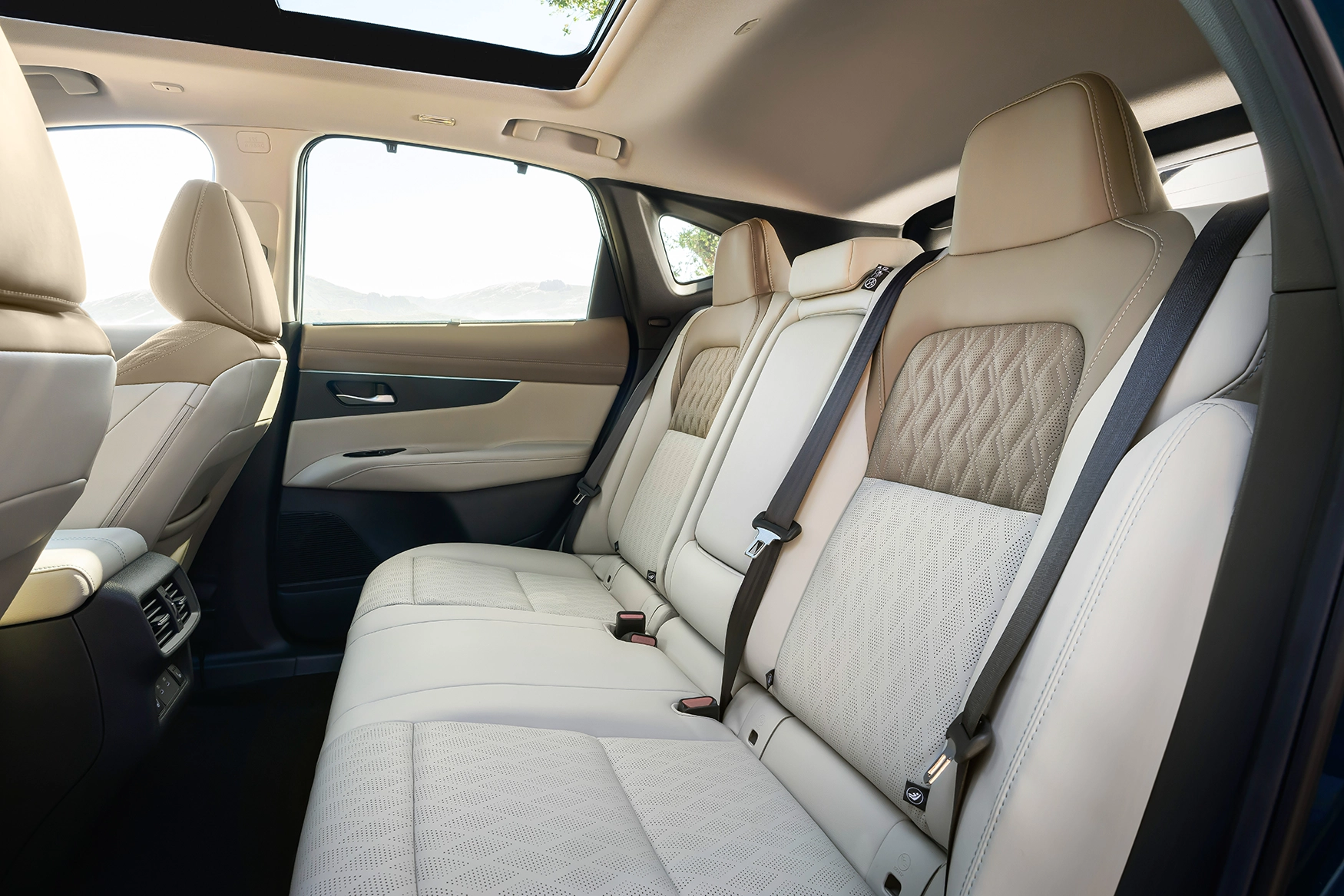
The Nissan Murano was designed with an important goal in mind: to make every drive more comfortable and convenient for all kinds of families, including those with young children and older grandparents.
With multigenerational households now representing nearly one-fifth of the U.S. population, engineers focused on enhancing the entry and exit to help families do more of what they love every day.
Why do vehicle ergonomics matter?
Vehicle ergonomics concerns making sure the driver and all occupants can get in, get comfortable and get back out again with ease.
Engineers worked to accommodate drivers of different heights, passengers of varied mobility levels and today's large infant car seats.
Whether driving a grandparent to a doctor's visit or a child to preschool, Murano was developed to make it easier.
"Nissan set ergonomics goals very early in the vehicle development process, even before digital design evaluations," said Terence Porter II, senior manager of human factors and ergonomics at Nissan Technical Center North America near Detroit. "Optimizing these measurements enhances the ease, comfort and accessibility of Nissan vehicles — key factors in customer satisfaction."
Seat that fits a wide range of drivers
The Nissan Murano's driver seat has a greater range of forward, backward and height adjustment than the previous generation, fitting drivers between 4 feet, 10 inches tall and 6 feet, 4 inches tall. That wide range helps more taller and shorter drivers get comfortable behind the wheel.
Plus, both front seats and the outboard rear seats feature Nissan's ultra-comfortable Zero Gravity technology.
Engineers even took the step of slightly flattening
the bottom of the steering wheel rim,
enabling an extra 0.75-inches of space.
This means it's easier for the driver's knees
to slide in and out of the vehicle.
Engineers also optimized the positions of the steering wheel and seat to ease entry and exit. The new Murano has significantly more space between the seat cushion and steering wheel rim than the outgoing model.

Murano's driver's seat can comfortably accommodate drivers between 4 feet, 10 inches tall and 6 feet, 4 inches tall. The steering wheel has a slightly flattened bottom, which makes it easier for taller drivers to enter and exit.
"While the previous Murano offered respectable knee room for front-row passengers, the all-new Nissan Murano takes comfort to the next level," said Porter. "Designed with taller occupants in mind, it delivers enhanced knee room and ergonomic refinement, setting a new benchmark in spaciousness and first-row comfort."
Making it easier to get in and out
Knowing that Murano drivers often have passengers in the back seat, Nissan engineers also focused on enhancing the ergonomics of Murano's second row.
For starters, the Nissan Murano's rear doors open very wide. At 78 degrees, they open about 10 degrees wider than the previous-generation model. Plus, it has more rear knee room than the 2024 Murano. Not only is it easier for those with limited mobility to get in and out, parents have more space to get bulky car seats or children in place.

Terence Porter II, senior manager of human factors and ergonomics at Nissan Technical Center North America, with his 2025 Murano.
Additionally, engineers ensured the Nissan Murano has excellent rear entry and exit; in other words, they made sure it's easy to step in or out of the vehicle. Careful measurement of the spacing between seat cushions, door openings and the vehicle's side sills were all maintained to achieve this goal.
Murano engineers scrutinized every detail
Throughout the Nissan Murano, designers and engineers sweated millimeter differences to give the crossover the best ergonomics possible.
For instance, they evaluated the height of the door armrests to ensure passengers could comfortably rest their elbows during long drives, and checked that the position of assist grips would help those with lower mobility get in and out of the vehicle more confidently.
Another example is Murano's electronic push-button shifter. Extensive research and testing determined it was easier for drivers to operate – with less hand movement required – than prior shifter designs. And the buttons are positioned at a slight angle so they are naturally positioned for the driver's hand to reach.
Murano's push-button shifter is slightly angled to allow for easy, intuitive operation.
Nissan puts a priority on comfort for all
Considering ease of entry and exit, as well as comfort for occupants of different sizes and mobility levels, is a core part of developing every new Nissan.
And it all starts with listening to the customer.
"We actively listen to our customers and seek their feedback to understand their needs and preferences," said Porter. "This guides our design decisions, ensuring that every ergonomic improvement adds meaningful value and contributes to delivering the best possible experience."
About the Nissan Murano
The all-new Nissan Murano was introduced for the 2025 model year with elegant design, high-tech features and an accommodating cabin, seamlessly marrying comfort and elegance to deliver a sanctuary-like experience. The 2026 Nissan Murano adds the convenience of available ProPILOT Assist 2.11, allowing for hands-off driving on compatible roads. It is on sale now with a starting MSRP of $41,670.
Like all Nissan vehicles, Murano was engineered to achieve high safety performance, and provides peace of mind with standard Nissan Safety Shield® 3602 on all grades. The 2025 Nissan Murano received a TOP SAFETY PICK+ designation by the Insurance Institute for Highway Safety (IIHS).
About Terence Porter II
Terence Porter II is the senior manager of human factors and ergonomics at Nissan Technical Center North America, located in Farmington Hills, Michigan. With over 23 years of experience at Nissan, he has built a diverse background spanning both design and testing functions. Porter holds a Bachelor of Science in Mechanical Engineering from Kettering University (formerly GMI).
# # #
- Consumer activation of NissanConnect Services ProPILOT Assist 2.1 package ("Package"" required for ProPILOT Assist 2.1 functionality. Package trial period included with new vehicle purchase. Trial period may be subject to change or termination at any time and without notice. After trial period ends, monthly subscription fee required. See www.nissanusa.com/connect/legal for more subscription information. ProPILOT Assist 2.1 cannot prevent collisions. It is the driver's responsibility to be in control of the vehicle and monitor traffic conditions at all times. Hands-off freeway driving is possible when driving in a single lane, on the condition that the driver remains attentive on the road ahead and is prepared to immediately take manual control of the steering wheel when conditions of the road, traffic, and vehicle require it. System operates only when lane markings are detected. Does not function in all weather, traffic and road conditions. System has limited control capability and the driver may need to steer, brake or accelerate at any time to maintain safety. See Owner's Manual for safety information.
- Driver-assist and safety features have limitations which affect how they function in certain situations. The driver must never rely exclusively on any vehicle feature to warn about, prevent, or lessen the severity of a collision. It is the driver's responsibility to always be in control, monitor the surroundings, and safely operate the vehicle. Read your vehicle's Owner's Manual for further information.
